
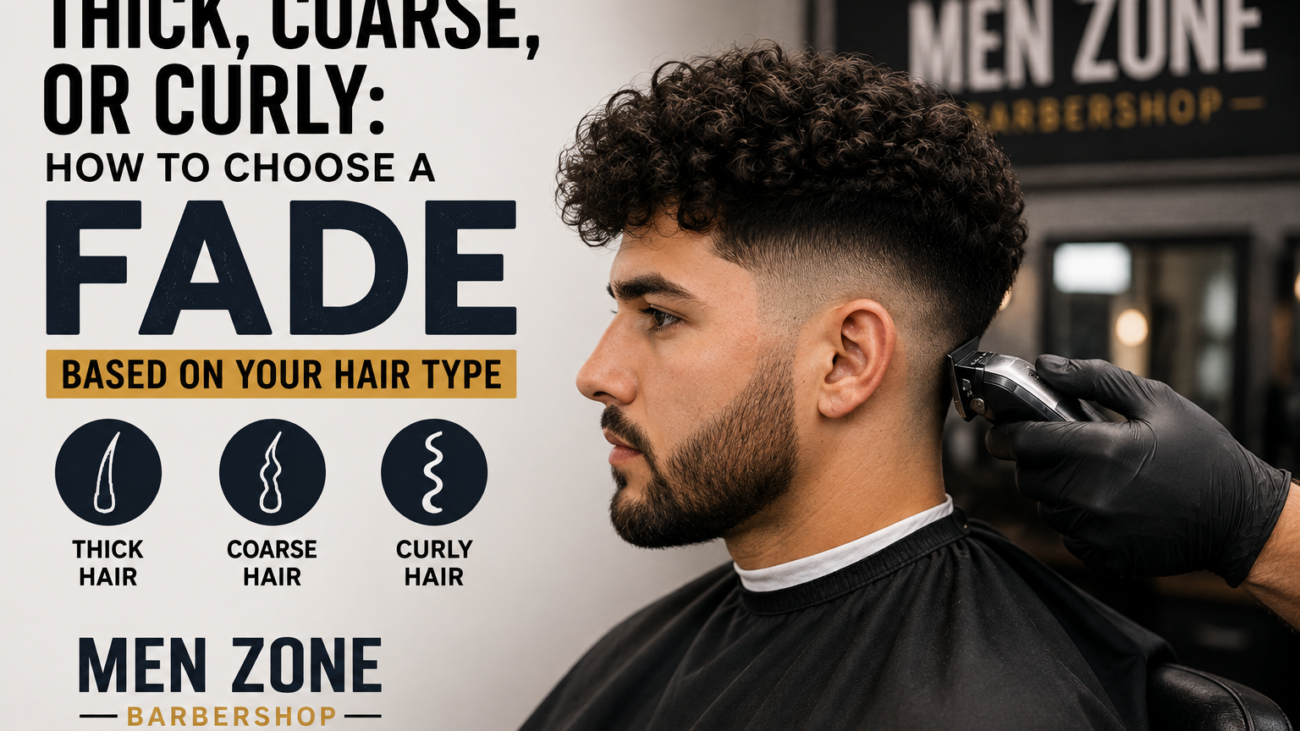
Not every fade looks the same on every head of hair. Your hair’s thickness, texture, curl pattern, and natural growth direction all influence how a fade will look and how long it will stay sharp. Choosing the right fade is less about copying a trending photo and more about finding a style that works with your natural hair.
Whether you have thick, coarse, or curly hair, understanding your hair type can help you and your barber create a cleaner, more balanced haircut.
Why Your Hair Type Matters When Choosing a Fade
A fade gradually blends the hair from shorter lengths around the sides and back into longer hair above. But the way that transition looks depends heavily on your natural texture.
Thick hair can create strong weight lines, coarse hair can appear especially dense around the temples and sides, while curly hair can make a fade look softer because of its natural texture.
That’s why finding a skilled Barbershop Near Me is only the first step. You also want a barber who understands how different hair types respond to fading techniques.
is only the first step. You also want a barber who understands how different hair types respond to fading techniques.
1. Fades for Thick Hair
Thick hair has plenty of density, which gives you lots of styling options. However, excessive bulk around the sides can make a haircut look heavy if the fade isn’t properly balanced.
Best options for thick hair:
- Mid fade
- High fade
- Skin fade
- Drop fade
- Textured crop with a fade
- Pompadour with a taper
A mid or high fade can remove unnecessary weight while leaving enough length on top for texture and styling. If you prefer a more conservative appearance, a low taper can clean up the edges without dramatically reducing the sides.
The key is controlling bulk without making the transition look too aggressive.
2. Fades for Coarse Hair
Coarse hair tends to have a stronger, more substantial texture. Because the individual strands can be thicker, the haircut needs precise blending to prevent harsh transitions.
A professional Barber in Oakville can adjust the fade according to how your hair grows and how much density you have around the temples, crown, and neckline.
Great fade choices for coarse hair:
- Low fade
- Mid fade
- Drop fade
- Taper fade
- Skin fade
For coarse hair, the right clipper technique is especially important. Removing too much hair too quickly can create an uneven appearance, while leaving too much weight can make the fade look disconnected.
A controlled fade combined with texture on top can create a clean, masculine finish without making the haircut look overly rigid.
3. Fades for Curly Hair
Curly hair offers natural volume and texture that can make a fade stand out. Instead of trying to eliminate the curls, a good haircut works around them.
Popular options for curly hair include:
- Low taper fade
- Mid fade
- Drop fade
- Temple fade
- Curly top with a skin fade
A low or mid fade can create contrast between the clean sides and the natural curls on top. Keeping some length allows the curls to maintain their shape rather than becoming too short and difficult to manage.
Your barber should also pay attention to shrinkage. Curly hair can appear significantly shorter when dry compared with when it is wet, so the desired length should be discussed before cutting.
Low Fade vs. Mid Fade vs. High Fade
Understanding fade placement can make your haircut consultation much easier.
Low Fade
A low fade begins closer to the ears and neckline. It provides a subtle, polished appearance and works particularly well when you want to preserve more hair around the sides.
Mid Fade
A mid fade starts around the middle of the sides and creates a stronger contrast. It is versatile and works well with many hairstyles and hair textures.
High Fade
A high fade removes more weight from the sides and creates a dramatic contrast with the hair on top. It can be especially effective for thick hair when you want a cleaner, sharper appearance.
Don’t Forget the Drop Fade
A drop fade follows the natural curve of the head and drops lower toward the back. This creates a distinctive shape and can work particularly well with textured, curly, or thick hairstyles.
For men who want something more interesting than a traditional fade, the drop fade can provide extra definition while maintaining a natural connection between the sides and back.
Consider Your Hairline and Growth Pattern
Your hair type isn’t the only factor that matters. Your hairline and natural growth pattern can significantly affect the finished haircut.
Cowlicks, uneven growth, crown patterns, and receding areas may require adjustments to the fade. A skilled barber can modify the fade height and transition to work with these characteristics rather than fighting against them.
How to Explain Your Desired Fade
Instead of simply saying, “Give me a fade,” be specific about what you want.
Tell your barber:
- How short you want the sides
- Whether you prefer a low, mid, or high fade
- How much length you want on top
- Whether you want a natural or sharp finish
- How much styling you normally do
- How frequently you plan to maintain the haircut
If you have a reference photo, bring it along. Your barber can then determine how closely the style can be adapted to your hair type.
You might also like: Experience Personalized Men’s Grooming at Men Zone Barbershop in Oakville
Choosing a Haircut in Oakville for Your Hair Type
If you’re looking for a Haircut in Oakville, don’t choose a fade solely because it looks good in a photo. Consider whether the style matches your natural texture and daily routine.
For example, someone with thick straight hair may benefit from a structured mid fade, while someone with tight curls may prefer a low taper that keeps the natural texture prominent.
At MEN ZONE Barbershop, the focus is on adapting the haircut to the client’s individual hair characteristics. The goal isn’t simply to reproduce a trend—it’s to create a fade that complements your texture, face shape, and personal style.
How Often Should You Maintain a Fade?
Fades look their sharpest when the transition is clean. Depending on how quickly your hair grows and how precise you want the haircut to remain, you may need regular maintenance.
A skin fade generally shows regrowth more quickly than a longer taper, while a low taper can remain presentable for longer between appointments.
Your lifestyle should therefore influence the fade you choose. If you don’t want frequent barber visits, a softer taper may be a better option than an extremely tight skin fade.
Final Thoughts
The perfect fade isn’t determined by a single trend. It’s determined by how well the haircut works with your natural hair.
Thick hair can benefit from fades that remove excess bulk. Coarse hair often requires careful blending and weight control. Curly hair can look excellent when the fade creates contrast while allowing natural texture to remain on top.
The next time you search for a Barbershop Near Me, think beyond the fade itself. Find a barber who understands your hair type, listens to what you want, and knows how to adapt the haircut to your natural growth pattern.
With the right technique, your hair texture doesn’t have to be something you work against—it can become the best feature of your haircut. MEN ZONE believes a great fade should feel personalized, practical, and built around the person wearing it.
Add a Comment