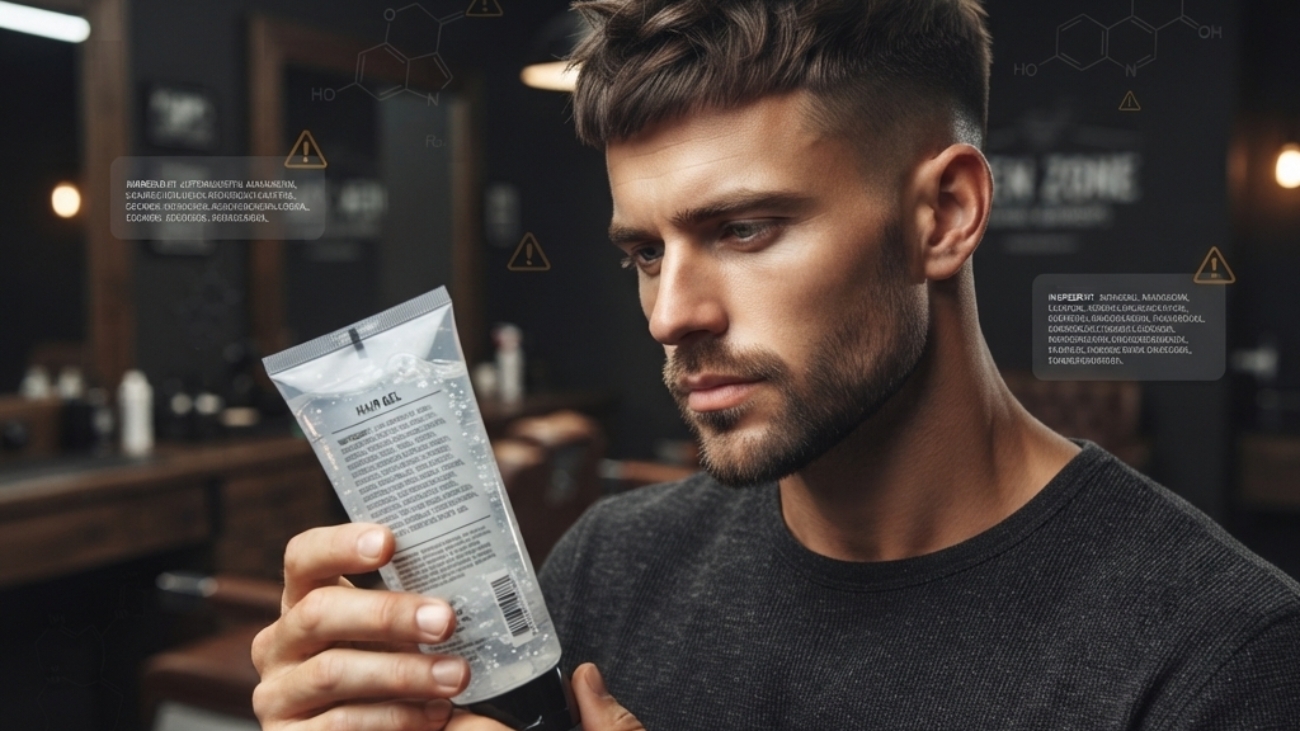
Man examining hair gel ingredients with MEN ZONE hair care tips

5 Toxic Ingredients Hiding in Cheap Drugstore Gels That Can Damage Your Hair

A strong-hold hairstyle can make your hair look sharper, fuller, and more polished—but the wrong styling gel may create problems you don’t immediately notice. While not every inexpensive hair gel is harmful, certain ingredients can be irritating or overly drying, particularly when a product is used heavily, left on the scalp for long periods, or combined with aggressive styling.

It is also important to separate hair damage and breakage from true hair loss. Hair loss has many possible causes, including genetics, illness, nutritional deficiencies, hormonal changes, scalp conditions, medications, and damaging hair-care practices. The American Academy of Dermatology recommends identifying the underlying cause rather than assuming a styling product is responsible.

If you regularly use styling gel, here are five ingredient groups worth recognizing on the label.

1. High Levels of Drying Alcohols

Not all alcohols in hair products are bad. In fact, some fatty alcohols, such as cetyl alcohol and stearyl alcohol, are commonly used as conditioning ingredients.

The ingredients worth paying attention to are short-chain alcohols such as alcohol denat., ethanol, or SD alcohol, especially when they appear prominently in a formula.

These ingredients can evaporate quickly and provide the fast-drying effect that makes some gels convenient. The downside is that frequent exposure can leave already-dry hair feeling rough, brittle, or difficult to manage.

According to Poison Control, alcohol-containing gels and mousses can have a drying effect, making hair more susceptible to damage during styling.

What to watch for

Look at the ingredient list for terms such as:

  • Alcohol Denat.
  • Ethanol
  • SD Alcohol
  • Isopropyl Alcohol

This doesn’t mean you must automatically throw away a gel containing one of these ingredients. The overall formulation and your individual scalp and hair type matter.

If your hair becomes unusually dry, stiff, or breaks easily after styling, consider switching to a gentler formula.

2. Strong Fragrance Components

That fresh, masculine scent may be one reason you like a particular styling gel, but fragrance can be problematic for people with sensitive skin.

“Fragrance” or “parfum” can represent a mixture of aromatic substances. Some individuals may develop irritation or allergic contact dermatitis after exposure to particular fragrance components.

When a styling product causes scalp irritation, you may notice:

  • Itching
  • Redness
  • Burning or stinging
  • Flaking
  • Increased sensitivity
  • Tenderness around the hairline

Persistent inflammation isn’t something to ignore.

If a gel consistently makes your scalp uncomfortable, stop using it and consider a fragrance-free or sensitive-scalp alternative.

Does fragrance directly cause baldness?

Usually, no. It is more accurate to say that an irritating or allergenic product can contribute to scalp inflammation or dermatitis, and severe or prolonged scalp problems may contribute to temporary hair shedding or damage. Hair loss itself has many potential causes.

3. Formaldehyde-Releasing Preservatives

Preservatives are necessary in many water-based cosmetic products because they help prevent microbial contamination. However, certain preservatives can cause irritation or allergic reactions in susceptible individuals.

Some ingredients that may release small amounts of formaldehyde include:

  • DMDM Hydantoin
  • Imidazolidinyl Urea
  • Diazolidinyl Urea
  • Quaternium-15
  • Bronopol

The presence of one of these ingredients does not automatically mean a product is dangerous or will cause hair loss. The important issue is individual sensitivity and the concentration/formulation.

If your scalp becomes persistently itchy, red, inflamed, or painful after using a particular gel, discontinue it and speak with a dermatologist if the problem continues.

A professional should also distinguish between cosmetic irritation and an underlying scalp condition.

4. Methylisothiazolinone (MI) and Methylchloroisothiazolinone (MCI)

MI and MCI are preservatives that have been used in cosmetic and personal-care products. They are particularly worth knowing about because some people can become sensitized to them.

If you’re sensitive to an ingredient, repeated exposure may produce symptoms such as:

  • Itching
  • Redness
  • Burning
  • Rash
  • Scaling
  • Scalp discomfort

A styling gel may not be the only source of exposure. These preservatives can appear in various personal-care formulations.

If you repeatedly experience scalp irritation after using a particular product, check the entire ingredient list rather than focusing only on the product’s price.

A smarter approach

Don’t choose a gel simply because it says “natural,” “professional,” or “premium.” Instead, look at the actual ingredients and consider how your scalp reacts to the formula.

5. Extremely Heavy Styling and Film-Forming Ingredients

This category requires an important clarification: film-forming ingredients themselves are not inherently toxic.

Ingredients such as PVP and various styling polymers are intentionally used in gels because they help hold the hair in place. The problem can arise when a person applies excessive amounts every day, repeatedly layers product, or aggressively brushes stiff hair into position.

Once hair becomes coated and stiff, rough handling can increase mechanical stress.

The American Academy of Dermatology explains that damaged hair is fragile and more likely to break. It also recommends gentle hair care for people experiencing thinning or hair loss.

So the bigger concern isn’t simply “this polymer causes hair loss.” It is the combination of:

Heavy product + stiff hair + aggressive brushing/combing + repeated styling = greater potential for breakage.

That distinction matters.

How Cheap Hair Gel Can Make Thinning Hair Look Worse

Suppose your hair is already becoming thinner because of genetics. Adding a strong gel won’t necessarily be the underlying cause.

However, excessive product can make the hair:

  • Look clumped together
  • Appear flatter
  • Reveal more scalp between strands
  • Feel stiff and brittle
  • Become harder to style gently
  • Break when manipulated aggressively

This can create the impression that the gel is “causing baldness” when the actual problem may be hereditary hair loss or another underlying condition.

The American Academy of Dermatology identifies hereditary hair loss as the most common cause of hair loss worldwide and emphasizes that finding the actual cause is important for effective management.

6 Signs Your Styling Gel May Not Agree With Your Scalp

Instead of waiting until you notice significant thinning, pay attention to early warning signs.

1. Persistent itching

If your scalp repeatedly becomes itchy after applying a particular product, take note.

2. Burning or stinging

A burning sensation isn’t a sign that a product is “working.” It may indicate irritation.

3. Unusual redness

Visible redness around the scalp or hairline can indicate irritation.

4. Excessive flaking

Sudden flaking after introducing a new styling product deserves attention.

5. Increased breakage

If you notice many short broken hairs rather than complete hairs coming from the root, mechanical or chemical damage may be involved.

6. Sudden or progressive thinning

Don’t automatically blame styling gel. Hair loss can have numerous causes and may require professional evaluation.

How to Choose a Better Hair Gel

You don’t necessarily need to stop using styling products completely.

Instead, choose products according to your hair and scalp.

Look for:

  • A formula appropriate for your hair type
  • Moderate rather than excessive hold
  • Less drying formulations if your hair is already dry
  • Fragrance-free options if you have a sensitive scalp
  • Products that don’t leave your hair extremely stiff
  • A formulation that washes out comfortably
  • Ingredients that you personally tolerate well

More expensive doesn’t automatically mean safer. Likewise, inexpensive doesn’t automatically mean dangerous.

The ingredient list, formulation, frequency of use, and your individual response matter more than the price tag.

You might also like: What to Expect During Your First Visit to a Barbershop in Vaughan

Better Styling Habits Can Protect Your Hair

Even a well-formulated gel can become problematic if it is used aggressively.

Try these simple habits:

Use less product

Start with a small amount and add more only if necessary.

Don’t aggressively brush hardened hair

If the gel has made your hair extremely stiff, forcing a comb through it can increase breakage.

Avoid constant scalp buildup

Cleanse your hair and scalp appropriately for your hair type rather than continuously layering fresh gel over old product.

Give your hair occasional breaks

If you don’t need strong hold every day, use lighter styling products or leave your hair relatively product-free.

Don’t ignore scalp symptoms

Pain, persistent stinging, crusting, inflammation, or noticeable hair loss deserves attention. The AAD specifically lists scalp symptoms such as stinging and crusting among warning signs associated with damaging styling practices.

When You Should See a Dermatologist

If you are experiencing genuine hair loss, don’t assume the styling gel is the culprit.

Hair loss can result from hereditary factors, nutritional deficiencies, hormonal issues, infections, medications, stressors, inflammatory scalp disorders, and damaging hair-care practices.

A dermatologist can examine your scalp and hair and determine whether you’re dealing with:

  • Hair shedding
  • Hair breakage
  • Hereditary hair loss
  • Scalp inflammation
  • Infection
  • Another form of alopecia

Early evaluation can be especially useful because some causes of hair loss benefit from early treatment.

Professional Grooming Without Overloading Your Hair

Choosing the right haircut can also reduce the temptation to use excessive amounts of styling gel.

At MEN ZONE, the focus is on creating practical men’s hairstyles that work with your natural hair texture, density, face shape, and lifestyle. A good cut can make styling easier, meaning you may not need to rely on heavy layers of gel to achieve your desired appearance.

If you’re searching for a Barber Near Me in the Kleinburg/Vaughan area, professional advice can help you choose a haircut and styling routine that suits your hair rather than simply masking problems.

For local grooming services, MEN ZONE Barbershop is located at 70 Barons St Bldg E Unit 3, Vaughan, ON L4H 3Y2, Canada, where men can discuss their preferred style and everyday grooming needs with a barber.

What About a Haircut in Kleinburg?

Your haircut can have a surprisingly large effect on how much styling product you need.

For example, a well-designed textured crop may require significantly less product than a heavily sculpted style. A barber can also adjust the length and weight distribution to make naturally fine or thinning hair appear more balanced.

If you’re looking for a Barber Kleinburg or planning your next Haircut Kleinburg, tell your barber how much time you want to spend styling your hair each morning.

A useful consultation should cover:

  • Your natural hair texture
  • Hair density
  • Growth pattern
  • Cowlicks
  • Hairline
  • Desired maintenance level
  • Preferred styling products
  • How often you normally wash your hair

The goal isn’t simply to make your hair look good when you leave the shop. It’s to create a style that remains manageable afterward.

Final Takeaway

The phrase “toxic ingredients causing hair loss” can make the issue sound simpler than it really is.

There is no universal list of five cheap-gel ingredients that automatically causes permanent hair loss. Some ingredients can contribute to dryness, irritation, allergic reactions, or hair damage in susceptible people, while excessive styling and mechanical stress can contribute to breakage. Meanwhile, common forms of hair loss may have completely different underlying causes.

The smartest approach is to read the ingredient label, pay attention to how your scalp and hair respond, avoid excessive product buildup, style gently, and seek professional medical advice when genuine or persistent hair loss occurs.

A great haircut can also reduce your dependence on heavy styling products. Whether you’re searching for a Barber Near Me, a Barber Kleinburg, or a quality Haircut Kleinburg, choose a professional who understands your hair type and can recommend a practical styling routine.

FAQs

1. Can hair gel actually cause permanent hair loss?

Usually, hair gel itself is not considered a primary cause of permanent hair loss. However, certain products may cause irritation or dermatitis, while aggressive styling can contribute to hair damage and breakage. Permanent hair loss has many possible causes and should be evaluated properly.

2. Is alcohol in hair gel bad for your hair?

Not every alcohol is harmful. Some fatty alcohols are useful conditioning ingredients. However, short-chain alcohols such as alcohol denat. can have a drying effect, particularly with frequent use. If your hair becomes dry or brittle, consider a different formulation.

3. How often should I use styling gel?

There is no universal number that works for everyone. If your hair and scalp tolerate a product well, occasional or regular use may be fine. If you experience itching, burning, dryness, flaking, or increased breakage, reduce or discontinue use and consider another product.

4. Should I stop using hair gel if my hair is thinning?

Not necessarily. First determine why your hair is thinning. If the gel causes irritation or makes your hair difficult to handle, switching products may help reduce additional damage. But hereditary and other forms of hair loss require a different approach.

5. What ingredients should I avoid if I have a sensitive scalp?

There is no single ingredient list that applies to everyone. If you have a history of sensitivity, you may want to avoid known personal triggers and consider fragrance-free products. If a product repeatedly causes a rash, burning, or significant itching, stop using it and consult a healthcare professional.

6. Does expensive hair gel mean it’s safer?

No. Price doesn’t determine whether a formula will suit your hair or scalp. An inexpensive product can work well, while an expensive product can still cause irritation for a particular person.

7. Can a haircut reduce the amount of gel I need?

Yes. A haircut designed around your natural texture, density, and growth pattern can make everyday styling considerably easier. Your barber can also recommend a suitable level of hold and product quantity.

8. When should I worry about hair loss?

See a dermatologist if you notice progressive thinning, bald patches, sudden heavy shedding, scalp inflammation, or other persistent changes. Hair loss has many causes, so identifying the underlying reason is more useful than automatically blaming one styling product.

9. Can product buildup cause hair loss?

Product buildup can make hair feel heavy, greasy, or difficult to manage and may contribute to scalp or skin problems in some people. The American Academy of Dermatology notes that hair products can contribute to skin problems around the hairline, so appropriate cleansing and product selection matter.

10. What is the safest way to use styling gel?

Use the smallest amount needed, avoid aggressively combing hardened hair, keep the product appropriate for your scalp, and stop using it if you develop persistent irritation. If you’re experiencing actual hair loss, investigate the underlying cause instead of relying only on a change in styling product.

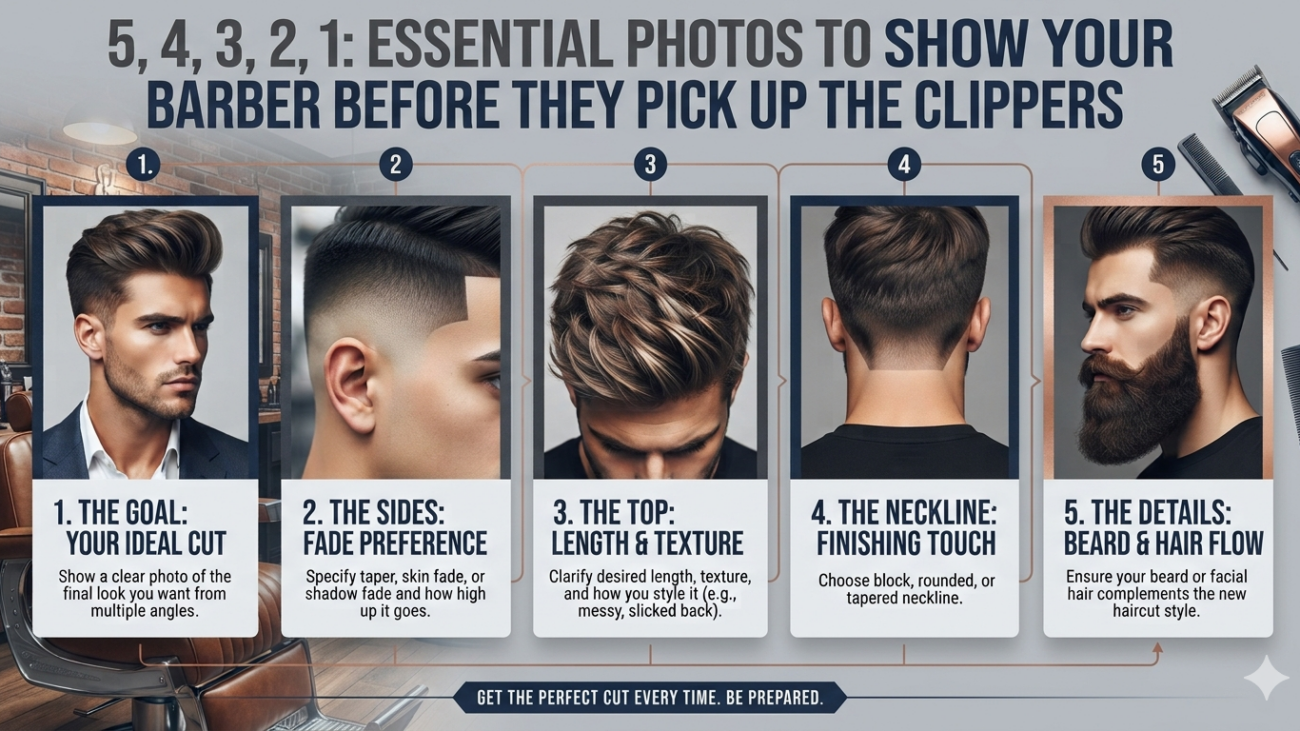
Infographic of 5 haircut photos to show your barber at MEN ZONE Barbershop in Oakville.

5, 4, 3, 2, 1: Essential Photos to Show Your Barber Before They Pick Up the Clippers

A picture can save you from a haircut you never intended to get.

You may walk into a barbershop knowing exactly how you want to look, but explaining that vision with words alone isn’t always easy. Terms like “low fade,” “textured top,” “short back and sides,” or “clean taper” can mean slightly different things to different people.

That’s why reference photos are one of the most useful tools you can bring to a barber.

But here’s the catch: not every haircut photo is equally useful.

Showing one random front-facing selfie may not give your barber enough information to understand the shape, fade, length, and finish you’re after.

A smart collection of reference photos can give your barber a much clearer blueprint.

Whether you’re searching for a Barber Near Me, considering a barber Oak Park, or looking for a Barbershop in Oakville, here are the five essential types of photos worth showing before the clippers start.


5 — The Front View: Show the Overall Shape

The first photo should show the haircut from the front.

This is your “big picture” reference.

Your barber can use it to understand:

  • Overall hairstyle
  • Fringe or front length
  • Hairline appearance
  • Amount of volume
  • Texture
  • Styling direction
  • General silhouette

For example, if you want a textured crop, the front view can show whether the fringe sits straight across, slightly forward, or naturally separated.

If you’re after a longer swept-back style, it can demonstrate how much visual height and movement you want.

Choose a useful front photo

Try to find a picture where the hair is clearly visible.

Avoid photos with:

  • Heavy filters
  • Hats
  • Extreme shadows
  • Sunglasses covering the face
  • Excessive hair products
  • Dramatic camera angles

The clearer the reference, the easier it is for your barber to interpret.

One important reminder

Don’t expect an exact copy.

Your hair may be thicker, thinner, curlier, straighter, or differently shaped than the model’s hair.

The photo is a direction, not a guarantee.


4 — The Side Profile: The Photo Your Barber Really Needs

If you could only bring two photos, the front and side views would be excellent choices.

The side profile reveals details that are almost impossible to understand from a front-facing picture.

It shows:

Fade height + temple shape + sideburn + top length + overall profile

This is particularly important when requesting a fade.

A photo may look like a “low fade” from the front, but the side view can reveal exactly where the fade begins and how high it travels.

What your barber can learn from a side photo

A side reference can show whether you want:

  • A low fade
  • Mid fade
  • High fade
  • Taper
  • Drop fade
  • Longer side length
  • Shorter sideburn
  • Strong temple definition

It also helps communicate how the top should connect to the sides.

If you’re visiting a barber Oak Park, don’t be afraid to show the side profile and say:

“This is the part of the haircut I really like.”

That tells your barber where your priorities are.


3 — The Back View: Don’t Forget What You Can’t See

Most clients focus on the front.

Some remember the side.

Very few think about the back.

But your barber has to create the haircut from every angle.

A back-view reference can help communicate:

  • Neckline shape
  • Fade progression
  • Hair length
  • Weight distribution
  • Taper around the neck
  • How the haircut finishes at the nape

Why the neckline matters

A neckline can completely change the personality of a haircut.

A natural neckline can create a softer appearance.

A squared neckline can provide a more structured finish.

A tapered neckline can create a cleaner transition as the hair grows.

None of these is automatically better.

The important thing is choosing the finish that works with your haircut and natural growth pattern.

Your barber’s job is three-dimensional

Think about it this way:

You aren’t asking for a picture.

You’re asking for a three-dimensional shape.

The front, sides, and back are all pieces of that shape.

That’s why multiple reference angles are so powerful.


2 — A Photo of Your Own Hair From Before

This might be the most overlooked reference of all.

Instead of only showing your barber someone else’s haircut, show them your own previous haircut.

Why?

Because your barber can see what your hair actually does.

A previous photo may reveal:

  • Your natural texture
  • Your growth direction
  • How your fringe falls
  • Your natural volume
  • Your hairline
  • Your cowlicks
  • How your fade grows out

If you loved your previous haircut, tell your barber why.

For example:

“I liked this length because it was easy to style.”

Or:

“I liked how the sides grew out, but I want the top slightly longer this time.”

That’s much more useful than simply saying:

“Do this again.”

Your barber now knows which parts to preserve and which parts to improve.


1 — The “After Styling” Photo: Show the Finish You Actually Want

The final and perhaps most important photo should show the hairstyle after it has been styled.

This is especially useful for longer, textured, curly, or swept hairstyles.

Why?

Because the haircut and the styling are two different things.

A photo might show:

  • Matte texture
  • High volume
  • Slick-back finish
  • Natural movement
  • Side-part styling
  • Messy texture
  • Defined curls

Your barber needs to understand whether you’re attracted to the haircut itself or the way it has been styled.

Ask yourself:

Do I want the haircut—or the styling?

That’s an important distinction.

A haircut may provide the foundation, but achieving the exact appearance may require:

  • Blow-drying
  • Hair clay
  • Pomade
  • Sea salt spray
  • Curl cream
  • Styling powder
  • A particular brushing technique

If you don’t want to spend 15 minutes styling your hair every morning, tell your barber.

They can adapt the haircut to your routine.


The Ultimate 5-Photo Haircut Reference Set

If you want to make your next barber consultation extremely simple, save these five images:

5. Front View

Shows the overall shape and front styling.

4. Side View

Shows fade height, side length, and profile.

3. Back View

Shows the neckline and rear fade.

2. Your Previous Haircut

Shows how your own hair behaves.

1. Finished Style

Shows the final texture and styling you want.

Together, these photos tell a much more complete story than one image ever could.


Don’t Just Show the Photos—Explain Them

Here’s where the real communication happens.

Don’t hand your barber five pictures and say:

“I want this.”

Instead, explain what you like in each one.

For example:

Photo 1: “I like the front shape.”

Photo 2: “I want this fade height.”

Photo 3: “I like this neckline.”

Photo 4: “This is how my hair looked when I liked the length.”

Photo 5: “I want this type of texture, but I don’t want to use much product.”

Now your barber has a complete set of instructions.

You aren’t asking them to copy five different hairstyles.

You’re giving them five pieces of information about one hairstyle.


Why One Photo Can Sometimes Be Misleading

Imagine you show your barber a photograph taken from the front.

The haircut looks fantastic.

But you can’t see:

  • How high the fade goes
  • Whether the sides are disconnected
  • How the neckline is shaped
  • How much length remains behind the ears
  • How the haircut looks from the side

Your barber has to guess.

And guessing is where misunderstandings begin.

This doesn’t mean you need a professional photoshoot.

Even two or three clear reference angles can dramatically improve communication.


Avoid Photos With Heavy Filters

Social media has changed how haircut photographs look.

Many images now include:

  • Skin smoothing
  • Hair enhancement
  • Artificial sharpening
  • Lighting effects
  • Face reshaping
  • Colour grading

These can make a haircut appear very different from reality.

Look for clean, natural reference images whenever possible.

The goal isn’t to find the most attractive photograph.

It’s to find the most informative photograph.


Consider Your Hair Texture Before Choosing the Photo

A reference photo should be realistic for your hair.

Straight hair

Look for references with similar thickness and natural movement.

Wavy hair

Choose photos where the waves have a similar pattern.

Curly hair

Pay attention to curl density and shrinkage.

Fine hair

Look for styles that achieve volume through shape rather than relying entirely on extremely thick hair.

Thick hair

Find references that show how bulk is managed rather than simply removed.

At Men Zone, the best reference isn’t necessarily the trendiest image online. It’s the one that gives your barber enough information to adapt the look to your natural hair.


What If Your Barber Says the Photo Won’t Work?

Don’t take it personally.

A good barber may tell you that a particular style needs modification.

That could be because of:

  • Hair density
  • Hairline
  • Cowlicks
  • Face shape
  • Hair texture
  • Existing haircut
  • Growth pattern
  • Maintenance requirements

Instead of asking:

“Can you copy this exactly?”

Ask:

“What version of this would work best with my hair?”

That’s a much more productive question.

The goal isn’t to recreate another person’s head.

The goal is to take inspiration from the photo and create something that works specifically for you.

You might also like: Why Professional Haircuts Are Easier to Maintain at Home


How Many Photos Should You Bring?

You don’t need 25 pictures.

In fact, too many can make the consultation confusing.

A strong collection of 3–5 carefully chosen photos is usually much more useful.

Choose photos that answer different questions:

What should the front look like?

How high should the fade be?

How should the back finish?

How should my hair be styled?

What did my previous haircut look like?

That’s enough to create a clear visual reference.


Show Your Barber What You Don’t Want Too

This is a clever trick that can prevent misunderstandings.

If there’s a haircut you’ve had before that you hated, take a picture.

Then explain:

“I don’t want this much weight on the sides.”

Or:

“I don’t want the fade this high.”

Or:

“I don’t like this neckline.”

Sometimes showing what you dislike is easier than explaining what you want.

At Men Zone Barbershop, a clear consultation can help turn reference photos into a haircut that fits the client’s hair, face shape, and lifestyle instead of simply reproducing an image.

For clients looking for a local option, the location is:

209 Oak Park Blvd Unit 102, Oakville, ON L6H 0M2, Canada


Before the Clippers Start: Use the 30-Second Check

Before your barber begins, quickly confirm four things:

Fade:
“Are we keeping the fade low?”

Top:
“Are we keeping this much length?”

Back:
“I want the neckline natural.”

Beard:
“Please blend the sideburn into the beard.”

This takes less than a minute.

But it can eliminate a lot of confusion.


Final Thoughts

The right haircut reference isn’t necessarily the coolest picture on your phone.

It’s the picture that communicates the most useful information.

A front view shows the overall shape.

A side view explains the fade.

A back view reveals the neckline.

A photo of your previous haircut shows how your own hair behaves.

And a finished styling photo explains the final look you’re trying to achieve.

Put those five pieces together, and your barber has a much clearer blueprint before picking up the clippers.

So next time you’re searching for a Barber Near Me, considering a barber Oak Park, or choosing a Barbershop in Oakville, don’t just bring inspiration.

Bring information.

A few carefully selected photos and a short conversation can turn “I want something like this” into a haircut that’s much closer to what you actually imagined.


Frequently Asked Questions

1. How many photos should I show my barber?

Three to five clear photos are usually enough. Choose different angles or photos that communicate specific details rather than showing many nearly identical images.

2. Should I show front, side, and back photos?

Yes. Multiple angles help your barber understand the haircut as a complete shape rather than trying to guess what the unseen areas should look like.

3. Can I show my barber a celebrity haircut?

Yes. Celebrity or model photos can be useful references. However, your barber may need to adapt the style to your hair texture, density, face shape, and hairline.

4. Should I bring a photo of my previous haircut?

Definitely. If you liked a previous haircut, the photo can help your barber understand what worked well with your natural hair.

5. What if my hair doesn’t look like the photo?

That’s completely normal. Your barber can usually adapt the important elements of the reference to suit your own hair and facial features.

6. Should my reference photo show the hair styled?

Yes, especially if you’re requesting a textured, swept-back, curly, or voluminous style. A styled photo helps communicate the desired finished appearance.

7. Are filtered haircut photos good references?

Natural photos are generally better. Heavy filters, artificial lighting, and editing can make hair texture, density, and colour appear different from reality.

8. Can I show my barber a haircut I don’t want?

Yes. Showing an unwanted haircut can be surprisingly useful. Explain exactly what you dislike about it so your barber knows what to avoid.

9. Should I explain what I like about each photo?

Yes. This is one of the best ways to use reference images. Tell your barber whether you like the fade, top length, texture, neckline, or overall shape.

10. What is the most important photo to bring?

There isn’t one universal answer, but a clear side-profile photo is especially valuable for fade-based haircuts because it shows the fade height and relationship between the top and sides.